CHAPTER EIGHT
Building the Dream
1970s
For the first time, Jim was truly at peace. This was a life without phones, calendars, deadlines, or monthly bills. After years of working with relentless, almost robotic exhaustion, he experienced a deeply sacred awakening. It was the same kind of peace he had briefly felt as a child when he rode his bicycle into the Everglades and spent his days immersed in beauty and tranquility. Now that feeling was present every day. Like the Everglades, this place was raw, untamed, and alive.
The jungle clearing embodied simplicity at its core. It was camping in the wild, though changes were already underway. There were a handful of weathered A-frame thatched huts elevated above the ground, with ladders leading to the sleeping quarters. A three-sided thatched structure at ground level served as storage for supplies. There was little protection from wildlife stealing food. Chickens roamed freely throughout the camp. An oversized flour tin served as a makeshift oven. Fortunately, Gino had grown up on a ranch in Arizona and was adept at campfire cooking.
There was no electricity, running water, or telephones. The latrine consisted of a deep pit crawling with snakes and rats eight feet below. Night-time use was pure terror for the kids. It was important to cling to the short fence posts surrounding the pit or risk falling in. Such a fall could prove deadly if a bushmaster snake happened to be lurking below.
A nearby pathway wound through dense foliage and led to a beautiful cascading waterfall, with orchids clinging to the rocks on either side. The entire walk was cooled by the waterfall's mist. Along the path, there seemed to be a powerful energy in the air. Distant sounds of the long-departed indigenous people could still be heard for those who were receptive enough to listen.
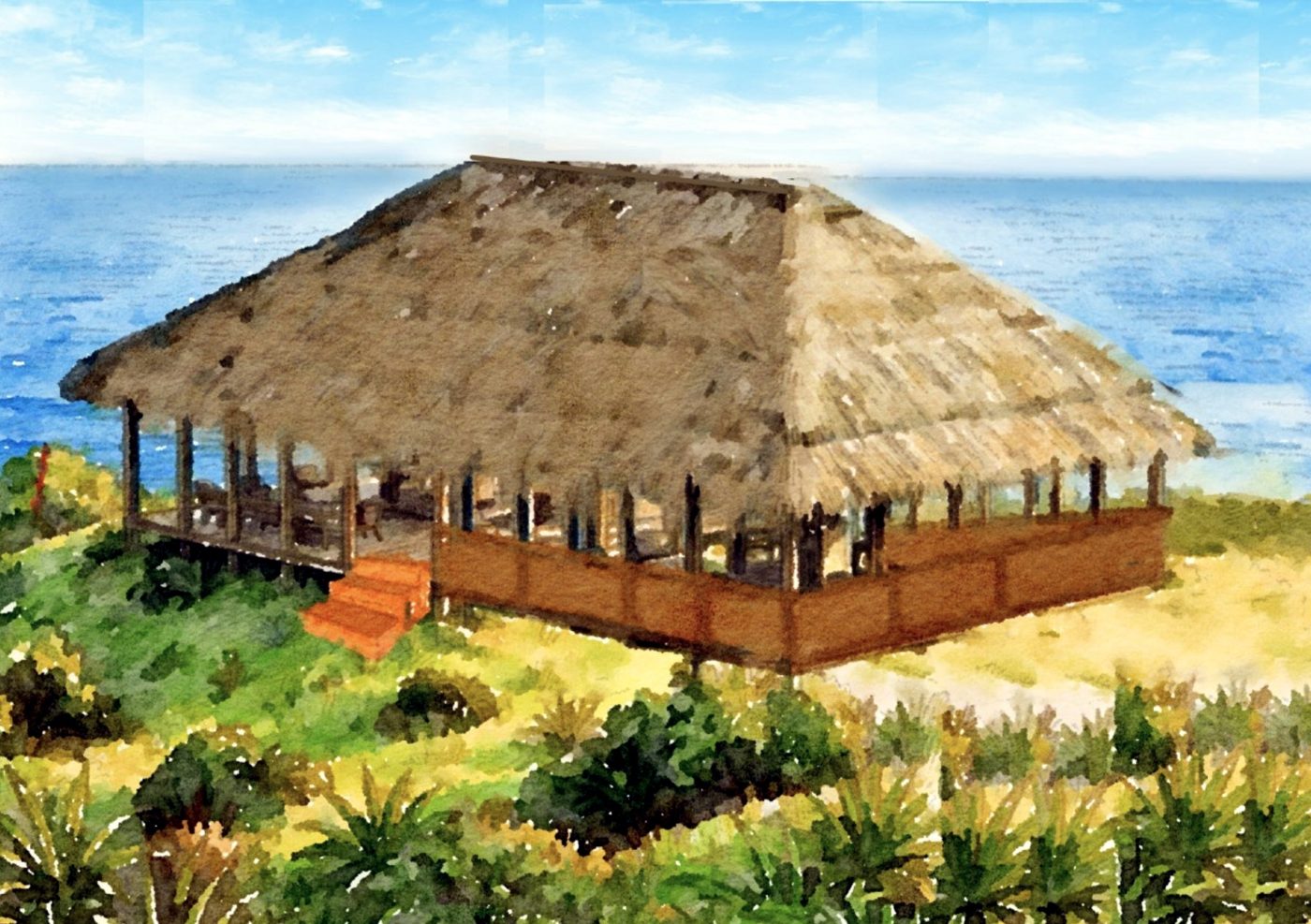
Beyond the sleeping huts, a large thatched sombra, an open-air living space, was under construction. Bobby, Gailon, Richard, and Jan had contracted the work when they arrived a few months earlier. High above, workmen were completing the roof. With each step in that direction, the immense scale of the open-sided thatched sombra structure became more apparent.
The rear portion of the sombra faced the pathway leading up to the sleeping huts and the gentle hills beyond. The front opened to an unobstructed view of the blue-green Pacific Ocean. Gentle breezes and the sound of the waves created a restorative, almost hypnotic atmosphere. The sombra sat atop a hill overlooking dense jungle below, interwoven with groves of cacao, bananas, papayas, and coconut palms. There was no doubt this was paradise. James had found his dreamland here, and could not leave.
The back section of the sombra housed the future kitchen, where shelves would soon be stocked with supplies. A large wooden dining table stood at the center, flanked by benches on either side. Water was being brought to the kitchen sink using split bamboo pipes that carried water by gravity from the waterfall far back and above.
A hammock had been added to the living area of the sombra, surrounded by burlap sacks filled with hard corn. Lounging in the hammock was a convenient way to shuck the corn before storing it in large tins. A few goats, two horses, and a stray puppy had also come to live on the finca .
At sunrise and sunset, bats flew overhead in great swarms. At night, they would often bite the necks of the horses and goats, making it necessary to build an enclosed barn to protect them.
A short walk from the sleeping huts, an open-air bathroom was nearing completion. It featured a double-seat wooden throne with sweeping views of the valley below. This royal privy was a no-flush design, relying on sawdust to aid in composting waste.
The finca was taking shape. Within a few weeks, additional sleeping huts had been added. A supply trip to San Isidro included the purchase of an iron wood stove, a kerosene refrigerator, and a pedal-powered sewing machine.
Whenever they sat in the sombra, Jim would encourage Giovanna to send letters to her mother. Finally, she finished her first one nearly a month into their jungle arrival. Giovanna’s letter described the beautiful, tropical paradise of Finca Avabacu . The letter was sent off with the most recent supply trip and postmarked San Isidro. It was the only letter she managed to send.
The nights beneath the sombra were illuminated by two Coleman kerosene lanterns. Flashlights lit the paths leading to the sleeping huts. Dinner was simple, usually consisting of rice and beans, with occasional fresh fish caught in the ocean below.
Canned tuna was often added to meals, and eggs were readily available as well.
Up the road lived Lusmilda, her husband José, and their two young daughters in a cement-block home with a hard red clay floor. José served as caretaker for the ranch. Chickens and pigs wandered freely in and out of the house.
Lusmilda was strikingly attractive and wore a shade of lipstick best described as papaya orange, though she wore no other makeup. Music constantly played from her battery-operated radio. For sleeping, the family shared two very narrow wood-slat beds without padding. The two girls were in one bed, and Jose and Lusmilda in the other.
Lusmilda agreed to take in the finca 's laundry. A gentle stream ran beside her home, making it an ideal place for washing clothes. Giovanna would carry loads of sweat and clay-stained clothes to Lusmilda and she became friends with Lusmilda's daughters. Sometimes, when Lusmilda was returning the freshly washed clothes, she would bring handmade tortillas too.